
Research
COMEX Wasn't Buying Silver. It Was Making Change
we checked all 48 appearances of firm 991, 48 exact conversions, 0 ounces kept
· By the ByShovel Research Desk
Two March Substack essays said CME's own house account had become the "buyer of last resort," absorbing 82 percent of a day's silver deliveries; one said it did so to keep the system from seizing. The same evening's PDF shows 570,000 ounces of micro contracts leaving one page earlier, issued by the same account. We checked every appearance of firm 991 in the 154 daily delivery reports we hold, silver and gold, January 15 to August 28: 48 for 48, the ounces tie exactly, six ran in reverse, and the running balance ends at zero.
What we checked
- Claim checked
- Two March 21, 2026 Substack essays (Gold and Geopolitics, The Silver Academy) said CME's own house account, firm 991, had become the buyer of last resort: it stopped 114 of 138 silver delivery notices on March 19, 82 percent of the day's deliveries, to keep the system from seizing up.
- Archive window
- The Vault Report's firm-level delivery archive: 154 of the 162 daily COMEX delivery reports published January 9 to September 1, 2026. Eight sessions were never captured (May 5 to 8, May 27, June 30, July 29 and August 3) and cannot be recovered.
- Documents examined
- Every appearance of firm 991 across all 697 report sections in the archive, silver and gold, full-size and micro, with five decisive days re-read line by line from the archived PDFs (SHA-256 hashes recorded on every parsed row), plus CME's 1,000-oz. Silver Futures FAQ and COMEX Rulebook Chapter 120 on ACEs.
- Result
- 48 appearances, 48 exact ties: every full-size stop matched same-day micro issuance in the same contract month at 5 to 1 in silver and 10 to 1 in gold, six ran in reverse, and the account's running balance ends at zero ounces in both metals. The clearing house was making change, not buying silver; verdict update October 1, on the page.
- Sources
- Gold and Geopolitics: Clearing member 991, the buyer of last resort (March 21, 2026), the claim under check
- The Silver Academy: COMEX PANIC: Clearing House Quietly Becomes Buyer of Last Resort (March 21, 2026)
- CME Group: FAQ: 1,000-oz. Silver Futures, the ACE definition and creation mechanics in CME's own words
- COMEX Rulebook Chapter 120: Micro Gold Futures, ACE issuance and the 10-to-1 redemption rule
- Interactive Brokers: COMEX Precious Metals Futures, ACE ratios for micro gold and micro silver
- CME Group: NYMEX and COMEX delivery notices, the daily report our archive captures
- The Vault Report: COMEX delivery notices, firm level, updated daily
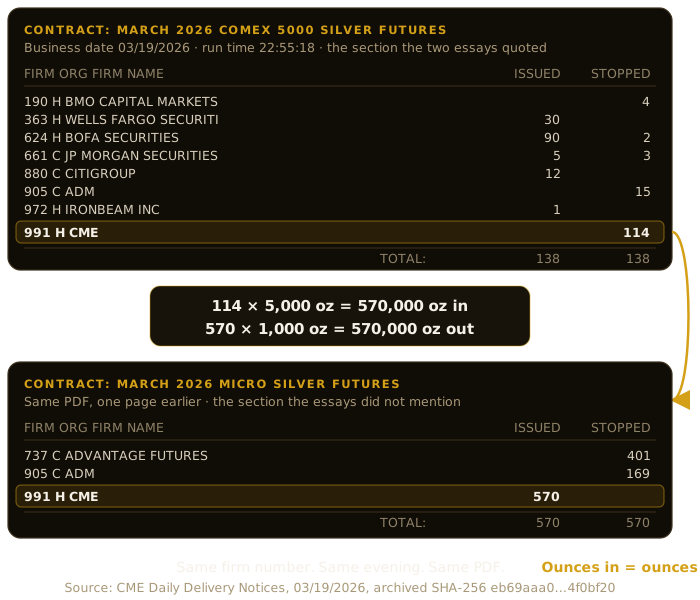
On March 19, the COMEX daily delivery report showed something that looks alarming if you stop reading halfway through the PDF. Of 138 full-size silver delivery notices that evening, 114 were stopped by firm 991, org H: CME's own house account, the clearing house itself. Two Substack essays published that week read the line, called the clearing house the buyer of last resort, and concluded it had stepped in with its own balance sheet to keep deliveries from failing. One page earlier in the same PDF, the same account issued 570 micro silver contracts: 570,000 ounces, the same quantity, going straight back out the door. Firm 991 did not keep the silver. It sent the same number of ounces back out the same evening in smaller denominations. The clearing house was not rescuing anybody. It was making change.
The claim, as published
First, the report's grammar, because everything below depends on it: the short who hands metal over issues a delivery notice, and the long who takes delivery stops it. Every evening CME publishes who did which, by clearing firm, with the exchange's own house account listed under firm number 991.
On March 21 the Substack Gold and Geopolitics published an essay titled "Clearing member 991," subtitled "The buyer of last resort":
"And clearing member 991 - CME, house account - stopped 114."
"The exchange itself absorbed 82.6% of the day's deliveries. 570,000 ounces caught by the referee. At what point does the referee scoring most of the goals make it a totally different game altogether?"
"The banks are throwing silver across the counter as fast as they can. And on the other side... tumbleweeds."
The same day, The Silver Academy ran the same reading under the headline "COMEX PANIC: Clearing House Quietly Becomes Buyer of Last Resort as Silver Delivery Pressure Explodes" (its em dashes are rendered as commas here):
"The CME's own house account, the clearinghouse itself, just stopped 114 out of 138 delivery notices for the March silver contract. That's 570,000 ounces, or roughly 82% of the day's entire delivery flow, absorbed by the exchange to keep the system from seizing up."
"When the house account becomes the buyer of last resort, it means the shorts can't deliver, full stop."
"This isn't 'routine logistics.' It's the market's plumbing fraying under real physical pressure."
In fairness to the first essay, it listed a benign reading among four possibilities, "just keeping the lights on," before spending its weight on the others: metal being piped to London to backfill SLV, an anonymous sovereign buyer, or CME buying for its own account. Neither essay mentions the micro silver contract, and neither mentions the section of the report where the answer sits.
The arithmetic in both pieces is accurate. 114 of 138 is 82.6 percent, and both essays read the right line of the right report. The month-to-date figure they cite, 8,681 contracts, is also real: it is the whole market's running total for the March contract across all firms, of which the house account had stopped 157, or 1.8 percent. The numbers are fine. The reading is not.
What the same PDF says, one page earlier
The March 19 report (run time 22:55:18, archived byte for byte in our system that evening) has a section the essays never mention: MARCH 2026 MICRO SILVER FUTURES. It is three lines long.
- ADVANTAGE FUTURES, customer account: stopped 401
- ADM, customer account: stopped 169
- CME, house account, firm 991: issued 570
114 full-size contracts stopped at 5,000 ounces each is 570,000 ounces in. 570 micro contracts issued at 1,000 ounces each is 570,000 ounces out. Same evening, same report, same firm number. The clearing house took delivery of full-size silver with one hand and handed the same quantity of ounces to micro-sized longs with the other.
The "shorts can't deliver" reading has a second problem, and it is structural: a delivery notice cannot go unreceived. Every section of every daily report balances, issued equals stopped, because a notice is the pairing of a short with a long. Across the 154 daily reports we hold since January 9, that is 697 report sections. The number that fail to balance is zero. On March 19 the shorts delivered 138 contracts and every one was received. The other side was not tumbleweeds. It was 570 micro-sized longs standing for 1,000-ounce deliveries through the customer accounts of two retail-facing brokers, and the clearing house doing the arithmetic between them.
Forty-eight appearances, forty-eight exact ties
One day could be a coincidence, so we pulled every appearance of firm 991 in our firm-level archive. That archive holds 154 of the 162 daily delivery reports CME published between January 9 and September 1, 2026, all metals. Eight sessions were never captured and, because CME does not archive the report, cannot be recovered: May 5 to 8, May 27, June 30, July 29 and August 3. Everything below is a claim about the 154 reports we hold, and we say so again where it matters.
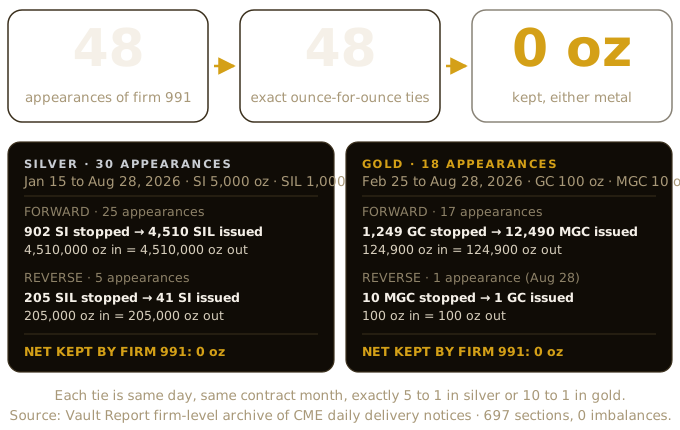
The account shows up in exactly four contracts and no others: full-size silver (SI) and micro silver (SIL), full-size gold (GC) and micro gold (MGC). Grouped by day, contract month and metal, that is 48 appearances on 42 trading days, January 15 to August 28, each appearance being a pair of report sections, one full-size and one micro. All 48 tie exactly:
- Silver, forward gear (25 appearances): 902 full-size contracts stopped, 4,510 micro contracts issued. Both sides are 4,510,000 ounces. The contract ratio is exactly 5 to 1 on every single day.
- Silver, reverse gear (5 appearances on 4 days): the machine ran backwards on May 28, July 30, July 31 and August 28: 205 micro contracts stopped, 41 full-size contracts issued, 205,000 ounces each way. On May 28 both gears turned in one evening, in two different contract months, and both legs still tied.
- Gold, forward gear (17 appearances): 1,249 full-size contracts stopped, 12,490 micro contracts issued. Both sides are 124,900 ounces, exactly 10 to 1 every time.
- Gold, reverse gear (1 appearance): on August 28, 10 micro gold contracts stopped and 1 full-size contract issued, 100 ounces each way. The first reverse gold day in our window, and it tied like the rest.
Net ounces retained by firm 991 across the 154 reports: zero in silver, zero in gold. Two of the eight uncaptured sessions, May 27 and July 29, sit inside stretches where the account was active on adjacent days, so an appearance we never saw is possible. What we can say is that of the appearances we hold, none has failed to tie.
The day that actually deserved an essay came four months after the one that got two. On July 20 the house account converted 438 full-size silver contracts into 2,190 micros: 2,190,000 ounces in one session, 3.8 times the March day that made the rounds. Nobody wrote it up. By then the delivery report had stopped being content.
One receipt on our own work. We first drafted this piece on August 20, when the count stood at 43 of 43. Since then five more appearances have printed: August 24 (108 gold contracts to 1,080 micros, and 4 silver to 20), August 26 (1 silver to 5), and the two August 28 reversals above. All five tied. The count is now 48 of 48, and the prediction the draft made about them held.
The machine has a name and a rulebook
None of this is a leak or an inference about motive. Micro gold and micro silver futures do not deliver warehouse warrants; they deliver an Accumulated Certificate of Exchange, an ACE, which is a fractional interest in a full-size warrant, and the issuer of ACEs is the clearing house. CME's own 1,000-oz. Silver Futures FAQ puts it plainly:
"An ACE, or Accumulated Certificate of Exchange, was created by the CME clearing house for the 1,000-oz. Silver Futures contract. It represents a 20% ownership in one, 5,000-oz. COMEX silver warrant ... When five ACEs are accumulated, they may be redeemed for one, 5,000-oz. COMEX silver warrant. Conversely, a short wishing to deliver against a 1,000-oz. Silver Futures position may only deliver an ACE."
And on how ACEs come into existence:
"The broker will deposit the COMEX silver warrant with the clearing house. This warrant will be held as collateral; the clearing house will create five ACEs and transfer them back to the broker (or clearing firm). Delivery against the 1,000-oz. Silver Futures contract is made with these ACEs."
Gold works the same way at 10 to 1. COMEX Rulebook Chapter 120, Micro Gold Futures: "the buyer's clearing member receives and the seller's clearing member delivers an Accumulated Certificate of Exchange ('ACE'), issued by the Clearing House. An ACE represents a 10% ownership in a 100-troy ounce gold bar held in the form of a Warrant," and "ACEs may only be redeemed for a Warrant upon the accumulation of ten (10) such ACEs." Interactive Brokers summarizes both ratios for its customers.
Now walk one delivery through. A customer at Advantage Futures is long one micro silver contract and stands for delivery. She is owed an ACE, one fifth of a 5,000-ounce warrant. Somebody has to break a whole warrant into fifths, and the FAQ says who: a full-size warrant is deposited with the clearing house, which creates five ACEs against it. On the delivery report that conversion prints as two lines under the clearing house's own firm number. In the full-size section, firm 991 stops the warrants coming in from the shorts. In the micro section, firm 991 issues the ACEs going out to the micro longs. When micro shorts deliver more ACEs than micro longs want, the same machine runs in reverse: on May 28, ADM customer accounts delivered 515 micro silver contracts, Advantage Futures took 334, RJ O'Brien took 1, the clearing house took the remaining 180, and that same evening firm 991 issued 36 full-size contracts, 180,000 ounces, to full-size longs. Five ACEs back into one warrant, 36 times over.
That is the entire content of firm 991's line in the report. The Silver Academy wrote that this "isn't routine logistics." It is precisely routine logistics. It has a certificate type, a conversion ratio, and a rulebook chapter.
What the reports establish, what CME establishes, what we infer, what we do not know
The delivery reports establish: firm 991 appears only in the four products above; in all 48 appearances its full-size and micro legs land on the same day, in the same contract month, at exactly 5 to 1 (silver) or 10 to 1 (gold); the machine runs in both directions; its net position over the window is zero ounces in each metal; and all 697 report sections in our archive balance, so no delivery went unreceived.
CME's own documents establish: what an ACE is, that it is issued by the clearing house, the 5-to-1 and 10-to-1 ratios, that ACEs are created when a warrant is deposited with the clearing house and redeemed back into a warrant once the right multiple is accumulated, and that only an ACE can satisfy a micro delivery.
What we infer: that firm 991's paired lines are that conversion showing up in the delivery report, the clearing house taking in whole warrants and handing out ACEs to micro longs, and the reverse. We call this an inference because we have found no CME document that describes how the conversion prints on the daily notices report. The fit is exact on 48 of 48 appearances, which is why we are comfortable stating it as the reading.
What we do not know: the internal procedure, specifically whether the clearing house steps in by rule whenever micro longs outnumber micro shorts, or converts at a clearing member's request; who the ultimate micro longs are behind the Advantage Futures and ADM customer omnibus accounts; and anything before January 9, 2026, because that is where our archive starts. We cannot say what firm 991 did in 2025. We can say that in the eight months we hold, it has never once kept an ounce overnight.
The better story is who is standing for the small contracts
The 82 percent figure was percent of a small day. Across the reports we hold the house account stopped 902 of 44,200 full-size silver notices: 2 percent of the delivery market it supposedly props up, and every one of those stops went straight back out as micros. A buyer of last resort that ends every single day flat is not buying anything.
But firm 991's line is not noise. It is a meter, and what it meters is demand for physical delivery in small denominations, because the clearing house only has to make change when micro longs want more ACEs than micro shorts are delivering.
- Micro delivery is almost entirely clearing-house made. Firm 991 issued 12,490 of the 12,526 micro gold contracts delivered in our window, 99.7 percent. Real shorts almost never deliver micro gold; a holder of a 100-ounce warrant has little reason to hand out ten-ounce fractions. In micro silver the house issued 4,510 of 6,058, 74.4 percent, with one industrial-sized exception: ADM customer accounts issued 1,493 micros themselves.
- The demand side is narrow but real. Advantage Futures and ADM customer accounts stopped 12,360 of the 12,526 micro gold contracts (98.7 percent) and 5,591 of the 6,058 micro silver (92.3 percent). That is many small longs standing for delivery, funneled through two pipes.
- In gold the meter has read higher every delivery month we hold. Micro gold delivered through firm 991: 760 contracts in February, 3,000 in April, 4,130 in June, 4,600 in August, or 7,600 ounces rising to 46,000. Four delivery months is four data points, and we treat it as four, not a trend. Silver is lumpier: 415 micro contracts in January, 1,120 in March, 655 in April, 2,225 in July, and between 5 and 40 in each of the other four months.
- The channel is still small. Micros were 0.75 percent of gold ounces and 2.7 percent of silver ounces delivered in our window.
So the honest version of the story the essays wanted to tell is this: there is measurable appetite to take delivery of gold in ten-ounce pieces and silver in thousand-ounce pieces, it clears through two retail-facing brokers, and the exchange's plumbing is handling it exactly as designed. That is a story about retail-sized physical demand. A solvency drama it is not.
The scoreboard we will check, and when
- Every delivery report we capture. Any 991 appearance is checked against the same day's micro section at the contract ratio. One miss breaks our reading, and we will say so. A missed capture is reported as a gap, not glossed.
- The September silver month. First notices printed August 28: 3,830 full-size silver contracts, none of them to firm 991. Through September 1 the September micro silver section has not appeared and neither has the house account, which is what the reading predicts when micro longs are not yet standing. The month runs to September 30.
- The verdict update. October 1, on this page, in place, dated. The pre-registration above is the standard we will be graded against.
The firm-level delivery table updates daily at thevaultreport.com/comex/deliveries.
Method and receipts
The Vault Report captures CME's daily delivery notices report each evening and parses it into per-firm rows. The archive holds 154 of the 162 trading sessions from January 9 to September 1, 2026, or 697 report sections, with the raw PDF archived byte for byte and its SHA-256 hash recorded on every parsed row; the eight uncaptured sessions are listed above. For this piece the archive was verified two independent ways on September 2. First, a full archive scan of every firm 991 row, grouped by day, contract month and metal, comparing full-size stops times 5,000 (silver) or 100 (gold) against micro issues times 1,000 or 10, and the reverse legs swapped: 48 appearances, 48 exact ties, net zero. Second, a separate re-derivation by a second reader that reconciled roughly ninety figures in this piece, every point on the chart and every number in both figures, and re-read five decisive days line by line from the archived PDFs, whose hashes match the database rows exactly: March 19 (eb69aaa051ef500f…), May 28 (7aca34d1e8658a44…), July 20 (22b9f7c38953eada…), August 24 (15aba4b74305b85c…) and August 28 (b97f25ac58ea7937…). That second pass caught a misquotation and an overstated coverage claim in our own draft, both corrected before publication. The issued-equals-stopped balance invariant was recomputed across all 697 sections at the day, product, contract-month grain: zero imbalances. Quotes from both Substack essays are verbatim from their public pages as read on September 2, 2026, with the essays' em dashes rendered as commas and their paragraph breaks kept.
Anyone with the daily reports can re-run the check: group the notices by firm 991, convert contracts to ounces at 5,000, 1,000, 100 and 10, and compare the full-size and micro legs by day and contract month. The raw reports and our worked calculations are available to any reporter or creator on request, without conditions: [email protected].
Sources
- Gold and Geopolitics: Clearing member 991, the buyer of last resort (March 21, 2026), the claim under check
- The Silver Academy: COMEX PANIC: Clearing House Quietly Becomes Buyer of Last Resort (March 21, 2026)
- CME Group: FAQ: 1,000-oz. Silver Futures, the ACE definition and creation mechanics in CME's own words
- COMEX Rulebook Chapter 120: Micro Gold Futures, ACE issuance and the 10-to-1 redemption rule
- Interactive Brokers: COMEX Precious Metals Futures, ACE ratios for micro gold and micro silver
- CME Group: NYMEX and COMEX delivery notices, the daily report our archive captures
- The Vault Report: COMEX delivery notices, firm level, updated daily
Frequently asked questions
- What is firm 991 on the COMEX daily delivery report?
- It is CME's own clearing house account (firm name "CME", org "H" for house). On our reading it appears in the report when micro-sized deliveries need full-size warrants broken into fractional certificates, or fractions consolidated back into whole warrants. In the 154 daily reports The Vault Report holds for January 9 to September 1, 2026, every one of its 48 appearances (January 15 to August 28) ties exactly to the matching micro or full-size leg in the same report.
- Is the CME clearing house buying silver or gold for itself?
- Not in any report we hold. Every full-size notice firm 991 stopped in our January to August 2026 archive was re-issued the same day as micro contracts, ounce for ounce, and every micro contract it stopped was re-issued as full-size. Its running net position across the whole window is zero ounces in silver and zero in gold.
More questions
- What is an Accumulated Certificate of Exchange (ACE)?
- The instrument micro gold (MGC) and micro silver (SIL) futures actually deliver. An ACE is a fractional interest in a full-size COMEX warrant, issued by the clearing house: ten 10-ounce gold ACEs make one 100-ounce warrant, and five 1,000-ounce silver ACEs make one 5,000-ounce warrant. CME's own FAQ says only an ACE can satisfy a micro delivery.
- How big are micro deliveries compared with full size?
- Small but real: about 0.75 percent of gold ounces and 2.7 percent of silver ounces delivered in our January to August 2026 window. Micro gold delivered through the clearing house rose in each of the four gold delivery months we hold, from 760 contracts in February to 4,600 in August; four months is four data points, not a trend. Nearly all micro delivery demand cleared through customer accounts at two retail-facing brokers, Advantage Futures and ADM.