
Research
The SPR Is Falling Because Washington Lent Its Oil Out on Credit, and Nobody Has Recorded a Barrel Coming Back
172 Million Barrels Announced, 133.56 Million Awarded to 13 Firms in Five Sheets, 128.8 Million Gone From the Caverns, and the Public Paper Trail Ends at the Award
· By the ByShovel Research Desk
The Strategic Petroleum Reserve has fallen 128.8 million barrels since the week the 2026 emergency exchange was announced, to its lowest weekly reading since November 1982. The award sheets say who took the oil and how much. They do not say what each firm owes back, when, or at what premium, and no return has been reported. Here is the chain from announcement to award, what the contracts actually do, and what the public record cannot settle.
What we checked
- Claim checked
- The Strategic Petroleum Reserve is falling because of the emergency exchange the Energy Department announced on March 11, 2026, and the announcement's own figures (172 million barrels out, about 200 million back within the next year, at no cost to the taxpayer) can be tested against the award sheets and contracts DOE itself published.
- Result
- The exchange is real and the ledger reconciles: 133.56 million barrels awarded across five sheets to 13 firms, against 172 million announced and 258.5 million offered. The EIA series fell 128.8 million barrels between the week ending March 13 and the week ending August 28, which we read as delivery (an inference; the weekly figure nets every movement). The contracts transfer title to the contractor at the custody meter and require the barrels back with a premium inside windows that run to September 2028 and July 2029, not within the next year. No return has been reported. DOE has stated the premium four ways on four dates, none derivable from the sheets. The bid and scoring record is not public, so the documents can neither show favoritism nor rule it out, and no cost to the taxpayer is a claim nobody outside DOE can test from what is published.
Archive window, method and sources
- Archive window
- EIA weekly SPR crude stocks (WCSSTUS1), every week EIA has published from August 20, 1982 to August 28, 2026, 2,292 readings in our own archive; EIA's own series skips six weeks (September 3, 10 and 17, 1982; April 22, May 6 and May 27, 1983), so the calendar holds 2,298. DOE's five award-information sheets (March 20, April 10, April 17, May 11 and June 22, 2026) and the five requests for proposals behind them (DE-RP96-26PO00001 to 00005), read in full from spr.doe.gov.
- Documents examined
- Every recipient line on all five award sheets, summed and reconciled to each sheet's own stated total; sections B.1, B.5 and H.1 of every RFP (offered volumes, minimum premiums, return periods, title transfer); DOE's energy.gov announcements of March 11, March 20, April 10, April 17, April 30, May 11 and June 10, 2026; the IEA's March 2026 collective-action notice. Third-party trade-press breakdowns of the rounds were read as corroboration only. All figures recomputed on September 9, 2026.
- Sources
- DOE: United States to release 172 million barrels of oil from the Strategic Petroleum Reserve (March 11, 2026)
- DOE: Energy Department issues RFP to advance the 172 million barrel exchange (June 10, 2026; the 26 percent and 'three completed exchanges' statements)
- DOE SPR: exchange documents (award sheets, RFPs, amendments; the files open from the posting API, paths in the sources list below)
- EIA: Weekly U.S. ending stocks of crude oil in the SPR (WCSSTUS1)
- The Vault Report: Strategic Petroleum Reserve, the live weekly level
22 of 22 sources archived with SHA-256 on September 12, 2026 · independent second read by Gemini 3.1 Pro on September 12, 2026: pass with fixes · revision 13
The Strategic Petroleum Reserve held 415.4 million barrels in the week the Energy Department announced a 172 million barrel emergency release. It held 286.6 million in the week ending August 28, the lowest weekly reading since November 1982 in a series that begins in August of that year. The 128.8 million barrels in between did not leave as a sale. They left as an exchange: thirteen companies were awarded 133.56 million barrels under five award sheets, take title at the meter, and owe the reserve those barrels plus a premium at dates of their own choosing that run as late as July 2029. Not one returned barrel is on the public record.
Six numbers that are not the same number
Announcement, solicitation, award, delivery, return obligation, actual return. Six stages, six figures, and only the first of them is 172.
- Announced: 172 million barrels. DOE, March 11, 2026: a release of 172 million barrels from the SPR, the U.S. share of a 400 million barrel action by 32 IEA members, with "approximately 200 million barrels within the next year" to come back and "at no cost to the taxpayer". (Our page on how the 2026 release worked country by country covers the international half.)
- Offered: 258.5 million barrels, across five requests for proposals between March 13 and June 10: 86, 10, 30, 92.5 and 40 million. DOE offered half again what it announced, because an exchange only moves what someone bids for.
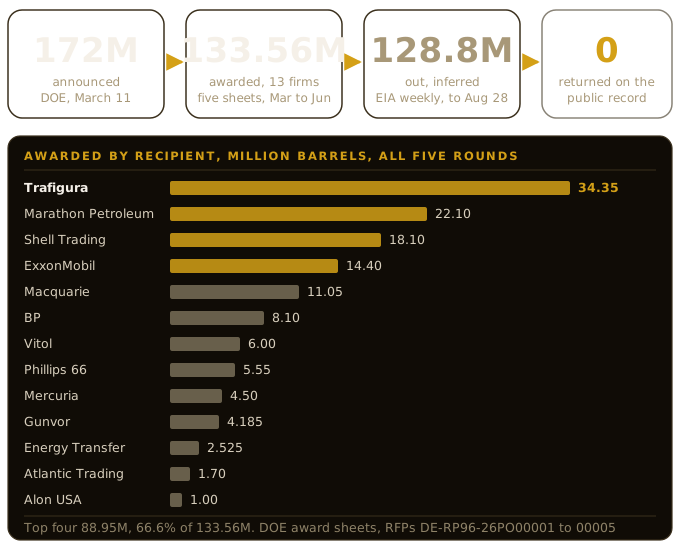
- Awarded: 133.56 million barrels, on five award-information sheets dated March 20, April 10, April 17, May 11 and June 22. The recipient lines sum to each sheet's own total in every round. That is 77.7 percent of the announcement and 51.7 percent of what was offered.
- Delivered: about 128.8 million barrels, by inference. The award sheets do not report deliveries. DOE gave two cumulative figures in prose, "more than 10 million barrels" by April 17 and "approximately 35 million" by May 11. The EIA weekly series fell 10.4 million through the week ending April 17 and stood 31.3 million lower on May 8 and 41.3 million lower on May 15 (31,347,000 and 41,267,000 barrels on the series, a 9,920,000 barrel week), so the prose and the series agree where they overlap. From there we read the series as the delivery meter: 128.8 million barrels out between the week ending March 13 and the week ending August 28 (415,442,000 to 286,604,000, a fall of 128,838,000), 96.5 percent of the 133,560,000 awarded. This is an inference. The weekly figure nets every barrel that moves in either direction, and DOE has published no delivery total since May.
- Owed back: the barrels plus a premium, each contract on its own schedule. The RFPs set return windows, not a date: as early as September 1, 2026 for round 1 barrels returning to Big Hill, and as late as July 2029 for round 2 barrels returning to Bryan Mound and West Hackberry. "Within the next year" is what the announcement said. The contracts do not require it.
- Returned: none reported. The earliest permissible return date passed on September 1. The EIA series has not risen in any week since March 20, and DOE has announced no receipt.
Who took it
Thirteen firms, from 34.35 million barrels down to one million. An award sheet is a name and a barrel count and nothing else, so this list is the whole of what the public record says about who has the oil.
- Trafigura Trading LLC, 34.35 million barrels, in four of the five rounds, 25.7 percent of everything awarded
- Marathon Petroleum Company, 22.10 million (16.5 percent)
- Shell Trading (US) Company, 18.10 million (13.6 percent)
- ExxonMobil Oil Corporation, 14.40 million (10.8 percent)
- Macquarie Commodities Trading US, 11.05 million
- BP Products North America, 8.10 million
- Vitol, 6.00 million, including the only award of the June round
- Phillips 66, 5.55 million
- Mercuria Energy America, 4.50 million
- Gunvor USA LLC, 4.185 million
- Energy Transfer Crude Marketing, 2.525 million
- Atlantic Trading & Marketing, 1.70 million
- Alon USA, 1.00 million
The top four hold 88.95 million barrels, 66.6 percent. Six of the thirteen are trading desks rather than refiners (Trafigura, Vitol, Mercuria, Gunvor, Macquarie and Atlantic Trading), and between them they hold 61.8 million barrels, 46.3 percent. The sheets vary a legal suffix between rounds (Marathon Petroleum Company LP in March, Marathon Petroleum Company in April) and we treat each pair as one recipient; whether any pair is two contracting entities is not settled by the record. Which site, which delivery month and which return period each firm took is not on any sheet, except that the April 10 and April 17 rounds were single-site, so those barrels came from Bryan Mound and West Hackberry respectively.
What the contract does: title moves at the meter
Here is what happens when one of these awards is executed, from the RFP's own terms. A trader bids on, say, 5 million barrels of Bryan Mound sour crude, crude with enough sulfur in it that only a refinery built to strip it out can run it, for June delivery, offering a premium above the round's minimum of 18 percent. DOE ranks the offers by premium, awards, and the trader's barrels flow to the custody transfer meter at the site. At that meter, under section H.1(a) of every one of the five RFPs, "title to the Exchange Oil delivered from the SPR will be transferred to the Contractor". The oil is now the trader's. It can be refined, sold to a refiner, loaded on a ship or held in a tank; the contract restricts none of that, and the only marine clause is the Jones Act requirement on the vessels that carry it. What the trader owes is "Return Oil": the 5 million barrels plus the premium, so 5.9 million or more, delivered back to the site inside the return period the trader picked from the RFP's menu, with title passing back at receipt under H.1(b). Each later return period carries a further adder, half a point to 4.5 percentage points, so waiting costs barrels.
Strip the government nouns and this is a commodity loan. Barrels now, more barrels later, the premium is the interest, paid in kind, and what the borrower does with the principal in the meantime is the borrower's business. In March 2026 that principal was worth a great deal, and the contract lets the holder monetize it at once and buy the return barrels whenever, inside the window, they are cheapest. That is legal, published, and the point of an exchange: DOE gets barrels back without an appropriation. It is also why the return schedule matters more than the headline. "Within the next year" is the announcement's reading of the arrangement. September 2028 and July 2029 are the ones in the contracts.
What DOE says it secured, and what the sheets let anyone check
The announcement promised about 200 million barrels back for 172 out, which is a 16 percent premium. Since then DOE has stated the premium four ways. March 20: 55 million barrels to be received against the 45.22 million on that round's award sheet, which is 21.6 percent. April 30: a 24 percent premium on the earlier exchanges. May 11: "approximately 28 percent return premium, representing 15.1 million barrels" for the second round, which is 28.3 percent of 53.33 million and above the top of that round's own minimum range of 18 to 24 percent. June 10: "a 26 percent premium in returned barrels" on the earlier exchanges. Four statements, four scopes, no reconciliation, and none of them can be derived from the award sheets, which carry no premium at all. Winning offers went to whoever bid furthest above the minimum, per section B.5, and the winning ratios were never published. The same June 10 announcement counted "more than 133 million barrels across three completed exchanges"; the sheets show four award rounds before June, totalling 133.06 million. Two DOE documents, two ways of counting the same barrels.
Then the June round. DOE offered 40 million barrels of sour crude with minimum premiums of 8 to 9 percent, less than half of any earlier round's, and awarded 500,000 barrels, to Vitol. That is 1.25 percent take-up after rounds that drew 53 to 87 percent. DOE has published no explanation. The lower minimums are on the RFP's face; what bidders made of the price of crude in June 2026 is their business, and the bid record that would answer it is not public.
None of this is hidden in the sense of withheld. It is unpublished. The award sheets, the RFPs and the amendments sit on a DOE server behind a page that never shows the file addresses, and DOE's own history-of-releases page listed no 2026 entry as of September 9, 2026. We fetched the documents from the posting API directly; the paths are in the sources below.
"No cost to the taxpayer" is a claim, not a finding
It might be true. It cannot be checked from the public record, and it is the wrong shape for a finding.
A present-value test would need, for each contract: the barrels delivered and the month they left; the barrels owed back and the return period selected; the market value of the outgoing barrels at delivery and of the incoming barrels at return; a discount rate for the two to three years in between; the cost of running the caverns, moving the oil and re-certifying its quality on the way back; and the value of the reserve's absence during the window, which is the whole reason a strategic reserve exists. The record publishes the first item as a total and none of the others per contract. A sale shows up in the federal budget as receipts. An exchange shows up nowhere, which is much of its appeal in Washington and most of the problem for anyone trying to audit it. A 26 percent premium in barrels over thirty months is a good deal for the reserve if crude is flat, and a poor one if the 2026 price spike gives way to a glut by 2028, and nobody outside DOE holds the schedule that would let them run the numbers. We are not asserting a loss. We are saying the claim is unaudited, and that it stays unaudited until DOE publishes the per-contract return schedule or the barrels come home.
Favoritism: what the sheets can and cannot show
Four firms hold two thirds of the barrels. Six trading desks hold nearly half. Trafigura alone holds a quarter, across four of five rounds. Those facts are consistent with an open competition among the handful of companies able to take 10 million barrels of sour crude at a Gulf Coast meter inside sixty days, and they are consistent with something worse. The award sheets cannot tell the two apart, and neither can we.
What would: the number of offerors per round; every offer, winning and losing, with its premium and return period; the ranking under section B.5 that produced each award; the evaluation memoranda; and any modification to an awarded contract, since the RFP amendments are posted (three for round 1, one for round 2) and contract modifications are not. Those records exist. They are the ordinary product of a federal solicitation, and they are what a records request or a congressional letter would ask for. Until they are public, this page reports the concentration as a fact, the missing scoring record as a limitation, and no verdict on motive in either direction. Absence of published evidence is not evidence of a clean process, and it is not evidence of a dirty one.
Method and receipts
The award figures come from DOE's five award-information sheets, fetched from the spr.doe.gov posting API on September 9, 2026 and read line by line; the recipient lines sum to each sheet's stated total in all five rounds, 45,220,000 + 8,480,000 + 26,030,000 + 53,330,000 + 500,000 = 133,560,000 barrels. The contract terms come from sections B.1, B.5 and H.1 of the five RFPs. The level figures are the EIA weekly SPR crude stocks series in our own archive, every week EIA has published since August 20, 1982, 2,292 readings, re-pulled for this piece (the calendar holds 2,298 weeks; the six EIA never published fall in September 1982 and April to May 1983); the lowest-since anchor was found by scanning the full series, not by reading a headline. Our June 19 page, The SPR is draining and did not stop at the ceasefire, called 340.3 million the lowest since 1983; at 286.6 million the anchor moves to November 1982. The delivery inference is the difference between two readings of that series and is labelled as such everywhere it appears. The premium statements are quoted from the DOE announcements they appear in, with their dates, and are not averaged. Third-party trade-press breakdowns of the rounds were read and matched the sheets; they are not cited as sources.
Next reading: the EIA weekly petroleum status report of September 10, for the week ending September 4, then every Wednesday, on /oil/spr. The grade lands December 2, on this page.
Sources
- DOE: United States to release 172 million barrels of oil from the Strategic Petroleum Reserve (March 11, 2026)
- DOE: Energy Department begins delivering SPR barrels at record speeds (March 20, 2026; 45.2 million awarded, 55 million to be received)
- DOE: Energy Department awards contracts for 8.5 million barrels, second phase (April 10, 2026)
- DOE: Energy Department awards new contracts, 26 million barrels (April 17, 2026; 'more than 10 million barrels' delivered)
- DOE: Energy Department issues RFP to continue swift execution of the 172 million barrel exchange (April 30, 2026; 92.5 million offered, 'a 24 percent premium in returned crude oil barrels' on the earlier exchanges)
- DOE: Energy Department awards contracts, 53.3 million barrels (May 11, 2026; 'approximately 28 percent', 15.1 million barrels; 'approximately 35 million' delivered)
- DOE: Energy Department issues RFP to advance the 172 million barrel exchange (June 10, 2026; 40 million offered, '26 percent', 'three completed exchanges')
- DOE SPR: exchange documents index (the page the award sheets and RFPs are posted under)
- DOE SPR: FY26 Oil Release No. 1, award information as of March 20, 2026 (45,220,000 barrels, 8 recipients)
- DOE SPR: FY26 Oil Release No. 1, request for proposal DE-RP96-26PO00001 (sections B.1, B.5, H.1)
- DOE SPR: FY26 Oil Release No. 1.a, award information as of April 10, 2026 (8,480,000 barrels, 4 recipients)
- DOE SPR: FY26 Oil Release No. 1.b, award information as of April 17, 2026 (26,030,000 barrels, 9 recipients)
- DOE SPR: FY26 Oil Release No. 2, award information as of May 11, 2026 (53,330,000 barrels, 9 recipients)
- DOE SPR: FY26 Oil Release No. 2, request for proposal DE-RP96-26PO00004 (return periods to July 2029)
- DOE SPR: FY26 Oil Release No. 3, award information as of June 22, 2026 (500,000 barrels, Vitol Inc.)
- DOE SPR: FY26 Oil Release No. 3, request for proposal DE-RP96-26PO00005 (40 million offered, minimum premiums 8 to 9 percent)
- DOE: History of SPR releases (no 2026 entry as of September 9, 2026)
- IEA: IEA member countries to carry out largest-ever oil stock release amid market disruptions from Middle East conflict (March 2026)
- EIA: Weekly U.S. ending stocks of crude oil in the SPR, WCSSTUS1 (the series behind every level figure here)
- The Vault Report: Strategic Petroleum Reserve, the live weekly level and the exchange ledger
- The Vault Report: How the 2026 oil release actually worked, one emergency, five playbooks
- The Vault Report: The SPR is draining and did not stop at the ceasefire (June 19, 2026)