
Research
Treasury Buybacks Are Not Stealth QE, Fact Checked
$463.6 Billion of Face Value Retired With $430.7 Billion of Borrowed Cash, the Fed Was Not the Buyer, and an Interest Bill That Rises $2.9 Billion a Year
· By the ByShovel Research Desk
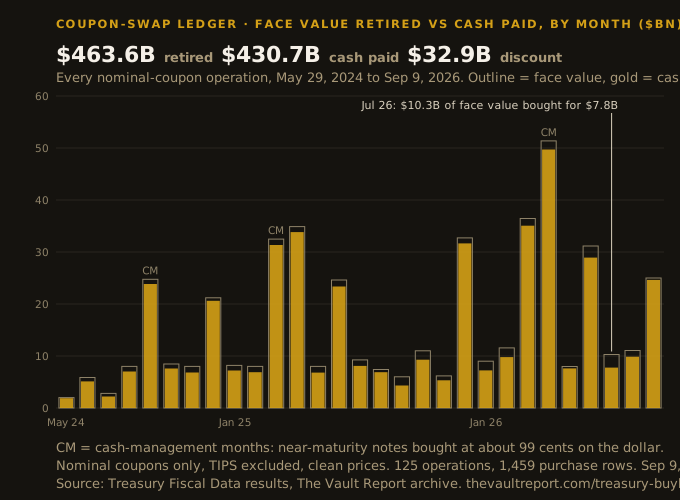
The Levy Institute's September 4 note reads the August 19 doubling as monetary policy run from the Treasury, which is what "stealth QE" means, and QE means bonds bought with created money. Our security-level ledger of every nominal-coupon buyback since May 2024 shows the other thing: 125 operations that retired $463.6 billion of face value for $430.7 billion of cash, every dollar of it borrowed, mostly as bills. No reserves were created. The swap is not free either: at today's 3.79 percent bill rate the interest bill runs about $2.9 billion a year above the coupons it cancelled, and the break-even bill rate is 3.13 percent.
What we checked
- Claim checked
- Treasury's doubled long-bond buybacks are "stealth QE": monetary policy run from the Treasury to push down long-term yields, and QE, as the Fed practises it, means bonds bought with money the buyer creates. For it: the Levy Economics Institute's September 4 note (Nersisyan and Wray), which reads the doubling as "an attempt to reduce pressure on long-term interest rates", "like monetary policy". Against it: TD Securities' Gennadiy Goldberg to Axios on August 19, "This is not QE," and Treasury Secretary Bessent's own "Treasury Twist" on CNBC.
- Result
- Not QE, and not free. $463.6 billion of face value was retired for $430.7 billion of borrowed cash; no reserves were created and the Fed was not the buyer. The cash costs more in bill interest ($16.3 billion a year at 3.79 percent) than the coupons it cancelled ($13.5 billion), so the swap adds about $2.9 billion a year, $8.1 billion at a 5 percent bill rate. The bills share, the lasting $201.7 billion book and the Operation Twist comparison are in the ledger below. Verdict re-read November 5, on this page.
Archive window, method and sources
- Archive window
- Every Treasury buyback operation since the program's first in March 2000: 221 operations and 5,963 security-level result rows, ingested from Treasury's Fiscal Data results feed after each operation, last refreshed September 9, 2026. This piece uses the 125 nominal-coupon operations from May 29, 2024, the first full-size liquidity-support operation, to September 9, 2026: 1,237 purchase rows, each carrying the coupon, the price paid and the maturity date. The bills share of marketable debt is from the Monthly Statement of the Public Debt, held monthly since January 2001 and charted from January 2024 (32 months); the bill rate is Treasury's monthly average interest rate on outstanding bills. The Federal Reserve's balance sheet is not in our archive, and nothing here measures it.
- Documents examined
- Every CUSIP-level purchase row joined to its operation (date and start time, because Treasury ran the same operation twice on August 21, 2024); TIPS excluded from every dollar figure; clean prices. Cash paid is face value times price over 100. Coupons cancelled is face value times coupon. Bill interest is cash paid times the bill rate, shown at the August 2026 average of 3.788 percent, at 4 percent and at 5 percent, and at each operation month's own bill rate. All figures recomputed in one pass on September 9, 2026.
- Sources
- Treasury Fiscal Data: Buybacks Operations and Buybacks Security Details (the results feed behind our archive)
- Treasury Fiscal Data: Monthly Statement of the Public Debt (bills and total marketable debt, January 2024 to August 2026)
- Treasury Fiscal Data: Average Interest Rates on U.S. Treasury Securities (marketable bills, 3.788 percent for August 2026)
- Federal Reserve: FOMC statement of September 21, 2011 (the maturity extension program, $400 billion, sell an equal amount)
- Federal Reserve: FOMC statement of June 20, 2012 (the program continued through the end of 2012)
- Axios: Treasury to double down on buybacks to steady bond market (August 19, 2026; Goldberg, "This is not QE")
- Levy Economics Institute: Treasury Buybacks, Much Ado About Nothing? (Nersisyan and Wray, September 4, 2026)
- CNBC: Bessent could tap near $1 trillion Treasury General Account to fund bond buybacks (August 24, 2026; the "Treasury Twist" remark)
- US Treasury: Treasury Announces Increased Sizes of Nominal Long-End Liquidity Support Buybacks Beginning September 9 (August 19, 2026)
- The Vault Report: Treasury buyback tracker, every operation and price, updated after each result
- The Vault Report: Why Treasury doubled its long-term bond buybacks (August 28, 2026)
10 of 12 sources archived with SHA-256 on September 12, 2026 · independent second read by Gemini 3.1 Pro on September 12, 2026: pass · revision 34
The US Treasury has not started printing money. Since May 29, 2024 it has run 125 nominal-coupon buyback operations that retired $463.6 billion of its own bonds and notes at face value, paid $430.7 billion of cash for them, all of it borrowed money, mostly bills that mature inside a year. The Federal Reserve is the bank the payment passes through, not the buyer, and once the week's bill auctions settle no reserves are left behind. On Treasury's side of the ledger, the only side our archive holds, the cash is bills; the discount of $32.9 billion is not a profit. What the ledger does show is a cost: at today's bill rate the swap adds about $2.9 billion a year to the interest bill, against the coupons it cancelled.
What QE is, and where a buyback's money actually comes from
Quantitative easing is a central-bank transaction. The Fed buys a bond from a dealer and pays with reserves, money it creates by crediting the dealer's bank; nothing refills the other side, and the Fed's balance sheet is larger by the purchase. That is the whole definition, and the phrase "stealth QE" claims it happened here.
A buyback runs differently, and the difference is in who pays. On a Tuesday afternoon Treasury opens a window for about 20 minutes and takes $175 million of the 1.875 percent bond of 2051 at $52.38 per $100 of face, which is what it did on August 18. It pays the dealer from its own account at the Fed, the Treasury General Account. That account is refilled by the week's bill auctions, which settle on Thursday; bill buyers' banks lose the reserves the dealer's bank gained. Once both legs settle, reserves are where they started and the public holds $175 million less of 2051 paper and about $92 million more of bills. Treasury's own August 19 release did not say how the doubled operations would be paid for. CNBC reported on August 24 that senior Treasury officials had not ruled out drawing the near $1 trillion cash balance, and that most of the market assumed bills. Either way the money is Treasury's, borrowed or already borrowed; neither source is a printing press.
The counter-position was on the record within hours. "This is not QE," TD Securities' Gennadiy Goldberg told Axios on August 19: Treasury has to pay for the long bonds it buys back by borrowing elsewhere, "their own little version of 'Operation Twist'". The better version of the QE argument, from the Levy Economics Institute's Yeva Nersisyan and L. Randall Wray on September 4, is about intent rather than money: aiming the doubled window at the 10-to-30-year sector "looks like an attempt to reduce pressure on long-term interest rates", which is to say "like monetary policy". On the aim, our ledger agrees with them: long-bond purchases went from $16.0 billion in 2024 to $40.8 billion in 2025 to $42.2 billion in the first eight months of 2026, and the September 10 operation carries a $6 billion cap against the old $2 billion: Treasury's release promised an increase "by at least double", a $4 billion floor, and set the first operation above it. Curve management is a fair description of the motive. It is not a description of the money, and "QE" is a claim about the money.
The ledger, in three tiers
Where the $463.6 billion went, from the 1,237 purchase rows, each tier to the nearest $1 million: the three tiers sum to $463.605 billion of face value and $430.733 billion of cash, which round to the $463.6 billion and $430.7 billion used throughout this page.
- Under two years to run: $295.973 billion of face value for $293.050 billion. Thirty-seven operations, coupons averaging 3.05 percent, a price of 99.01. Most of this, $261.9 billion, is the cash-management program, which buys notes about to mature around tax dates so that fewer bills need to be issued into the same weeks. Nothing about it changes the shape of the debt for long, because the paper would have matured anyway.
- Two to ten years: $68.642 billion for $66.217 billion. Thirty-seven operations, coupons 2.88 percent, price 96.47.
- Ten to thirty years: $98.990 billion for $71.466 billion. Fifty-one operations, coupons 2.50 percent, price 72.19, and $27.5 billion of the $32.9 billion total discount. This is the tier the doubling is aimed at, and the one where every stealth-QE thread starts.
The Forbes headline of August 22 asked where the money is coming from. The Monthly Statement of the Public Debt answers with a number. At the end of May 2024, the month the full-size operations began, Treasury had $5.87 trillion of bills outstanding, 21.7 percent of $27.0 trillion of marketable debt. At the end of August 2026 it had $7.25 trillion, 22.8 percent of $31.8 trillion. Bills grew $1.38 trillion over the window; the buybacks' $431 billion of cash is under a third of that; the deficit, and the maturing paper the Federal Reserve stopped rolling over, account for most of the rest, and neither is in this ledger. The share moved 1.1 points, from 21.7 to 22.8 percent, and August's reading is the highest month-end since February 2021. That is the funding side, in Treasury's own accounts: more bills, not more reserves.
The interest bill, which is the number that decides it
Retiring $100 of face value for $52.38 sounds like a $47.62 gain. The annual cash flows say otherwise, and they are the honest test of a swap. Cancelling $100 of the 2051 bond's face stops a coupon of $1.875 a year. Raising $52.38 of bills to pay for it costs $1.98 a year at August's average bill rate of 3.788 percent. The interest bill goes up by about 11 cents on that trade, every year, and it resets with every bill auction instead of staying fixed until 2051. The $47.62 of face value that will never be repaid is real, but it was not a gift: it is exactly what the market charged for a 1.875 percent coupon in a 5 percent world, and Treasury only collects it by no longer owing the principal in 2051.
Scaled to the whole ledger, computed row by row from the coupon and price of every bond bought:
- Coupons cancelled: $13.5 billion a year on $463.6 billion of face value at a par-weighted 2.904 percent.
- Bill interest on the $430.7 billion of cash raised: $16.3 billion a year at 3.788 percent, so the swap currently costs about $2.9 billion a year ($2.85 billion before rounding). At a 4 percent bill rate it is $3.8 billion; at 5 percent, $8.1 billion. Priced at each operation month's own bill rate, which averaged higher because bills paid 5.35 percent when the program began, the running cost was $4.4 billion a year.
- The break-even bill rate is 3.13 percent. Below it the swap saves money; above it the swap costs money. Bills have been above it for every month of the program.
Two honest deductions. The bill rate has fallen from 5.35 percent in May 2024 to 3.79 percent in August 2026, which shrank the delta by more than half; the number is a snapshot, and every rate cut makes the swap cheaper. And most of the ledger is the cash-management tier, whose notes would have been refinanced within a year regardless. The part of the swap that lasts is the liquidity-support book: $201.7 billion of face value with 10.9 years of average remaining life, bought for $171.3 billion, coupons 2.68 percent. That book cancels $5.4 billion of coupons a year and its bills cost $6.5 billion at today's rate: $1.1 billion a year of extra interest, $1.4 billion at 4 percent, $3.2 billion at 5. The 10-to-30-year tier on its own, $99.0 billion of face for $71.5 billion, comes out nearly flat today, $2.7 billion of bill interest against $2.5 billion of coupons, and breaks even at a 3.46 percent bill rate. The long end is the cheapest part of the swap to run, because the discount is doing so much of the work. Not printing money, then, and not quite free: a $2.9 billion line item that the next rate decision can move in either direction, which is the incentive worth watching. A borrower that keeps shortening its own debt has bought an interest in lower short rates.
Operation Twist, in the terms the record allows
Both sides of the argument reach for 2011: Goldberg called the buybacks "their own little version of 'Operation Twist'", and the Treasury Secretary called them "Treasury Twist" himself. The Federal Reserve's statement of September 21, 2011 said it would "purchase, by the end of June 2012, $400 billion of Treasury securities with remaining maturities of 6 years to 30 years" and "sell an equal amount of Treasury securities with remaining maturities of 3 years or less"; on June 20, 2012 it extended the program through the end of that year at the same pace. "Sell an equal amount" is the receipt: Twist was a swap inside a portfolio of fixed size, which is why it was not QE either.
Three things differ, and one does not. The actor: Twist was the central bank changing the mix of its own portfolio; the buybacks are the borrower changing the mix of what it owes. The funding: the Fed paid for long bonds by selling short bonds it held; Treasury pays by issuing bills it did not owe before, so the public debt is unchanged in dollars but shorter in years. The scale: $400 billion of long purchases in nine months is about $44 billion a month; the long-bond window took $42.2 billion in the eight months of 2026 through August 18, about $5.3 billion a month, an eighth of Twist's pace, and $99.0 billion over its 27-month life, $3.7 billion a month, a twelfth, even before the doubling. What does not differ is the direction: both operations took long-dated paper out of public hands and put short-dated paper in, which is the only sense in which "Treasury Twist" is the right label, and it is the label Mr. Bessent chose. The one comparison the discourse got right is the one the Treasury Secretary made himself.
What to watch, and when
- September 10: the first long-bond operation at the new size, 10-to-20-year, with a $6 billion maximum, above the $4 billion floor Treasury promised and triple the $2 billion door of every full-size long-bond operation before it. Treasury's results land in our feed the same evening; the buyback tracker carries the price paid and the coupon retired.
- Every operation after: the tracker updates within a day of each result, one to two operations a week through the quarter. Today's operation, a $12.5 billion cash-management purchase of notes with under two years to run, is already in the ledger above.
- Around September 30 and October 31: the Monthly Statement for September and October, which is where the bills share either keeps climbing or does not.
- November 4: the Quarterly Refunding, where Treasury sets buyback sizes beyond this quarter. The re-read of this page follows on November 5.
Method and receipts
Buyback figures are computed from The Vault Report's own archive of Treasury's published operation results: 221 operations since March 2000 and 5,963 security-level rows, ingested from the Fiscal Data feed after each operation and refreshed on September 9, 2026. The window is the 125 nominal-coupon operations from May 29, 2024, the first full-size liquidity-support operation, through September 9, 2026; the April 2024 trial operations of $200 million each are excluded, as are all inflation-protected purchases, whose prices need index adjustment. Operations are identified by date and start time because Treasury ran the same operation twice on August 21, 2024. Cash paid is face value times the accepted price over 100, using clean prices, the quoted price without the accrued interest Treasury also pays at settlement, so cash figures slightly understate settlement totals. Coupons cancelled are face value times coupon. Bill interest is cash paid times the bill rate; the rate is Treasury's monthly average interest rate on outstanding marketable bills, 3.788 percent for August 2026, with sensitivities at 4 and 5 percent and at each operation month's own rate. The bills share is bills outstanding over total marketable debt from the Monthly Statement of the Public Debt. Our $463.6 billion total reconciles to the $439.0 billion since April 2024 that we published on August 28, less the $0.4 billion of April trial operations, plus the two cash-management operations since ($25.0 billion, including today's). The Twist figures are the Federal Reserve's own statements and nothing beyond them. Next reading: the September 10 result, graded on this page the week it lands; the full re-run on November 5.
Sources
- Treasury Fiscal Data: Buybacks Operations and Buybacks Security Details (the results feed behind our archive)
- Treasury Fiscal Data: Monthly Statement of the Public Debt (bills and total marketable debt, January 2024 to August 2026)
- Treasury Fiscal Data: Average Interest Rates on U.S. Treasury Securities (marketable bills, 3.788 percent for August 2026)
- US Treasury: Treasury Announces Increased Sizes of Nominal Long-End Liquidity Support Buybacks Beginning September 9 (August 19, 2026)
- Federal Reserve: FOMC statement of September 21, 2011 (the maturity extension program, $400 billion, sell an equal amount)
- Federal Reserve: FOMC statement of June 20, 2012 (the program continued through the end of 2012)
- Axios: Treasury to double down on buybacks to steady bond market (August 19, 2026; Goldberg, "This is not QE")
- Levy Economics Institute: Treasury Buybacks, Much Ado About Nothing? (Nersisyan and Wray, September 4, 2026)
- CNBC: Bessent could tap near $1 trillion Treasury General Account to fund bond buybacks (August 24, 2026; the "Treasury Twist" remark)
- Forbes: Treasury Is Buying Its Own Bonds. Where Is The Money Coming From? (James Broughel, August 22, 2026)
- The Vault Report: Treasury buyback tracker, every operation and price, updated after each result
- The Vault Report: Why Treasury doubled its long-term bond buybacks (August 28, 2026)